The outcomes behind Nervana

Our Evidence

Progress you can see,
from symptoms to everyday life

01 / Symptom relief

Less severe
symptoms

For members who started with high symptom severity

29%*1

lower symptom severity
after session 10

85% reported an improvement

Symptom severity
Baseline8.1
After session 105.7

Average symptom severity · 0–10 scale

*1 40 matched respondents with starting severity 7–10. Average change from baseline to a check-in within 14 days after session 10.

02 / Healthcare use

Fewer urgent care
and ER visits

Less symptom-related urgent care in the first follow-up

50%*2

fewer urgent care
and ER visits

At the 30-day follow-up

Urgent care and ER visits
Baseline0.12
30-day follow-up0.06

Estimated visits per person per month

*2 67 matched respondents. Self-reported visit ranges converted to monthly estimates, comparing the prior 90 days with the follow-up’s prior 30 days.

03 / Out-of-pocket costs

Less spent
on symptoms

Early spending results from members with longer follow-up

48%*3

lower out-of-pocket
symptom spending

At the 90-day follow-up

Monthly symptom spending
Baseline$425
90-day follow-up$221

Estimated out-of-pocket dollars per month

*3 17 matched respondents. Estimated monthly spending from self-reported ranges. Spending did not decrease at the 30-day follow-up.

04 / Member experience

Support members
find helpful

91%*4

reported helpfulness or a specific
benefit by session 10

*4 96 of 105 respondents rated Nervana helpful or reported a specific benefit in their session-10 check-in.

From outcomes to research

Our research

Sharing what we learn as the evidence grows

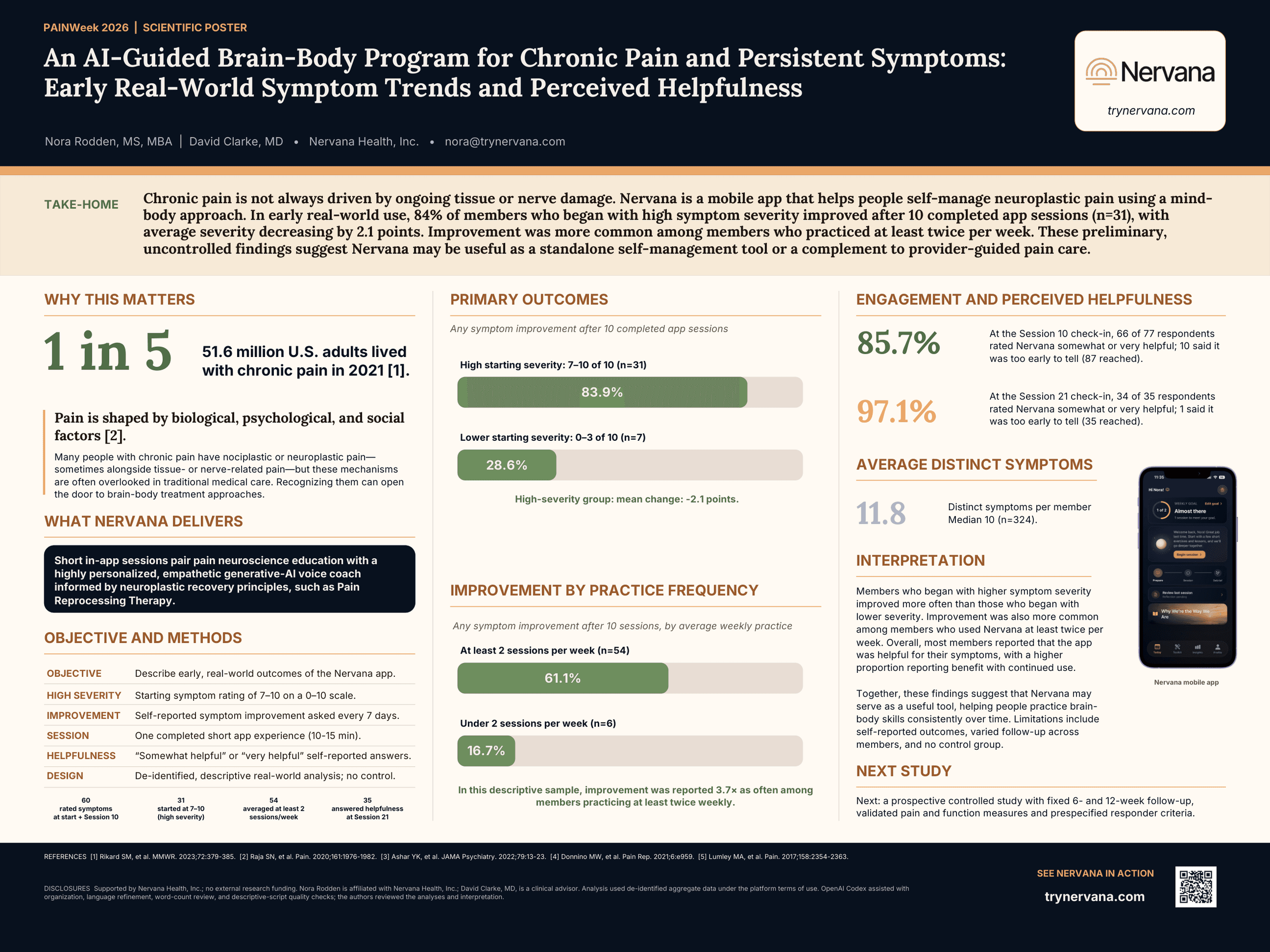
Nervana PAINWeek poster: early real-world symptom trends and perceived helpfulness

PAINWeek 2026 · Research poster

An AI-Guided Brain-Body Program for Chronic Pain and Persistent Symptoms

Early real-world symptom trends and perceived helpfulness among people using Nervana.

Nora Rodden, MS, MBA & David Clarke, MD

Read the full poster

Observational research with self-reported outcomes and no control group. The poster reports its original study cohort.

The clinical research behind our approach +

These studies informed Nervana’s approach. They tested clinician-delivered therapies, rather than the Nervana app.

Pain Reprocessing Therapy

Ashar et al. · 2022 · Randomized trial · 151 adults with primary chronic back pain

Read study

Psychophysiologic Symptom Relief Therapy

Donnino et al. · 2021 · Randomized pilot · 35 adults included in the analysis

Read study

Emotional Awareness and Expression Therapy

Yarns et al. · 2024 · Randomized trial · 126 older veterans with musculoskeletal pain

Read study

How Nervana AI is built

Under the hood
of Nervana AI

Research, personal context, and human clinical guidance shape each conversation.

Clinical research

A knowledge base of research, lessons, and coaching guidance

Personal memory

Your experiences, reflections, and preferences

Clinical expertise

Clinical guidance reviewed by our medical advisors

David Clarke, MDDavid Schechter, MDMark Bonta, MD, FRCPCMeet our advisors
Nervana AI coach

Personalized, action-oriented support

Designed around medical and emotional safety

Personal memory helps the coach build on your story. Knowledge-base improvements go through human review before they are approved. How we handle your information

Outcome data updated October 29, 2026

Internal, self-reported, observational data from respondents with matched measurements. Results do not establish cause and effect or guarantee individual outcomes. Nervana complements medical care.

Sources and methods +

Test and analytics-excluded accounts, plus active partner-access accounts other than guest passes, are excluded. Each outcome has its own respondent group; missing and declined answers are excluded from that outcome.

*1 Symptom severity: The first submitted 0–10 severity score is the baseline. High severity means 7–10. We use the first submitted check-in on or after completed session 10 and within 14 days. Every included completion had a full 14-day observation window. 40 of 52 eligible high-severity members had matched follow-up data; 34 reported a lower score. The 29% result is the change in the group’s average severity, rather than the percentage of members who improved. Session 10 is an app milestone, not a fixed number of days.

*2 Care use: 67 members answered both baseline and 30-day follow-up visit questions. Baseline covers the prior 90 days and is divided by three; follow-up covers the prior 30 days. Visit ranges use representative values, with “4 or more” set to 4. The percentage uses unrounded group averages; chart labels are rounded. These are symptom-related urgent care and ER visits, rather than all healthcare use.

*3 Spending: 17 members answered both baseline and 90-day follow-up spending questions. Dollar ranges use representative values and the same monthly conversion. Top ranges are capped at their lower bound. These are estimates, rather than verified receipts or total savings for all members. At 30 days, the separate matched group (n=60) averaged $389 at baseline and $394 at follow-up. The 90-day result is preliminary and based on a small group.

*4 Helpfulness: One session-10 response per member. 90 rated Nervana “very helpful” or “somewhat helpful”; another 6 reported a specific benefit in the same session. Together, that is 96/105 (91%). The remaining respondents reported “too early to tell” (8) or “not helpful” (1).
Make room for
a fuller life

Explore Nervana